
Pressure (2026)
D-Day as we haven't seen it before; the tidal turn of WWII that nearly didn't happen

Pressure (2026)
In theaters
“Great men” theories of history are no longer taught or believed in. We now recognize that fate can try the loftiest leaders and upend their most meticulous plans.
Pressure suggests that the best men and women can do is prepare to wrestle with events, then buckle down and let history happen.
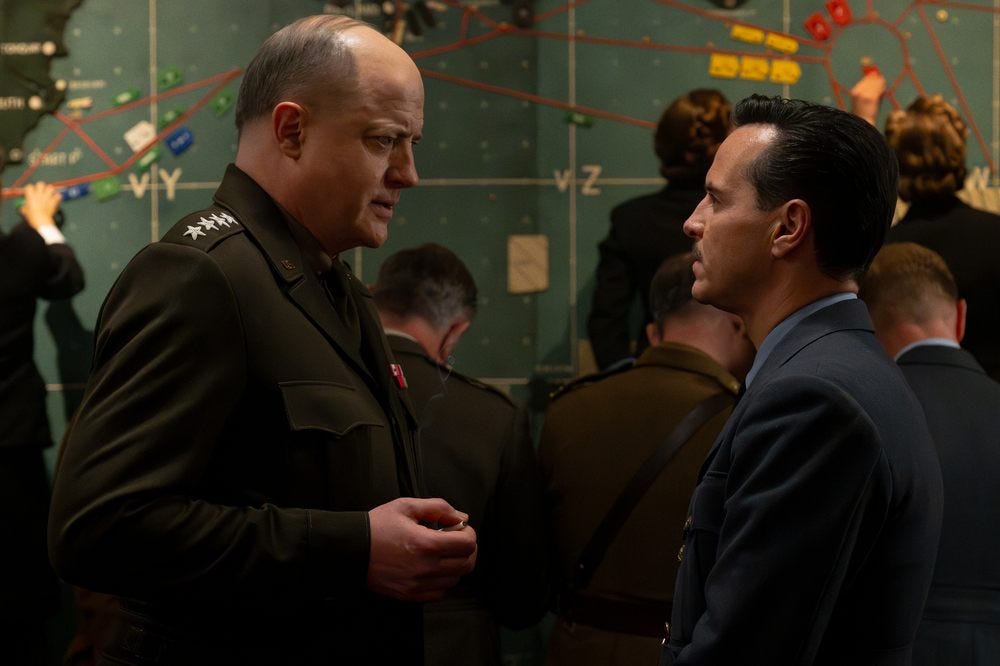
It’s June 1944 and General Dwight D. (“Ike”) Eisenhower (Brendan Fraser), Supreme Commander of the Allied Expeditionary Forces, has the lives of 300,000 men in his hands.
And sees before him the possibility that Hitler’s march toward the conquest of Europe can at last be decisively halted – or not.
If the murderous megalomaniac isn’t stopped now, the Allies could face months possibly years more of brutal, exhausting combat.
Months of preparation have gone into an incursion into Normandy, France, in what will be the largest amphibious invasion in history.
Landing boats packed with ground forces, aircraft able to parachute soldiers into enemy lines, naval gunboats bristling with cannons aimed at German positions all stand ready.
What could stop them? The weather. Readiness guarantees nothing when roiling clouds gather.
If the English Channel’s waves boil at eight to ten feet, winds whip at more than 30 mph, and dense cloud cover blocks the views of fighter planes, the mission can’t go forward.
And Hitler’s grip on France and the rest of Europe tightens.
Eisenhower needs the best possible weather forecast. Churchill has commended to him a gifted meteorologist, Group Captain James Stagg (Andrew Scott).
Winston has told Ike that Stagg is a “genius”. He may not have also informed him that Stagg is an intense, haughty Scotsman who doesn’t suffer fools. He also has a will of iron.
Eisenhower has been advised for much of his career by doggedly traditional weather forecasters led by Irving Krick (Chris Messina).
Krick and his team forecast the weather by closely studying the past. They believe weather patterns in the English Channel in early June going as far back as the 1920s will simply repeat this year. Early June for years has seen mild weather. This year will be no different.
Stagg hotly disagrees. British weather balloons and coastal readings on both side of the Channel are telling him and his team a very different story.
Stagg argues before a room full of military commanders that his team is writing current, real-time charts showing two violent storms heading right toward the Channel.
Which means that launching the mission on Eisenhower’s planned date of June 5 will lead to catastrophe.
Thousands of men will die in boats overturned by tossing seas, pilots will be blinded by cloud cover, Allied cannons will be firing blind.
Nonsense, counters Krick (Messina is deftly ornery in the role). Past patterns always prevail. June 5 will be bright and sunny.
That’s Eisenhower’s dilemma. We now know that D-Day unfolded on June 6 and, with a biting cost in lives, the Allies conquered. The Germans were driven out of Cherbourg three weeks later and in two months Paris was liberated.
But none of that was inevitable and Eisenhower could be assured of no such outcome. He also has reason to doubt himself.
Months earlier Operation Tiger had been launched as a trial mission. Germany had figured out Eisenhower’s strategy in advance, and more than 700 Allied troops had been killed. Their blood was on Ike’s hands.
This is bold, intelligent moviemaking. It takes events we think we know and recasts them with a doubt that we weren’t aware of and shows us people who gave their all not on the battlefield but in tight, close rooms where overwhelming decisions had to be made – now.
His faithful top aide for years, Kay Summersby (an impeccably controlled Kerry Condon), tells him to put that past torment aside and grapple with making the best decision now.
But who’s right, Krick or Stagg? June 5 or June 6, which is the better day? Delay any longer and the Nazis will spot the invasion the Allies are planning and thwart it.
Tension is pervasive. Fraser makes a surprisingly supple Eisenhower, ramrod stiff with discipline yet humanistic, too, fully aware that thousands of young lives are at stake.
Surely the fiercest American general we’ve seen on screen remains George C. Scott’s brawling, scary portrait in Patton (1970). I also admire Gregory Peck’s thoughtful, commanding performance in MacArthur (1977).
Fraser has a different acting challenge. For one thing, he stands at 6’3” while Ike was 5’10”. But Fraser smartly doesn’t try to make himself appear smaller, doesn’t shrink from towering over those around him.
The high aspiration of breaking the back of the Nazi advance drives Eisenhower. That’s what we’re always reminded of when Fraser squints in bewilderment or closes his eyes in what can seem like actual terror.
His responsibility and his unease constantly war with one another. Nothing for long seems certain in Fraser’s now shifting, now laser-focused eyes. That moment-to-moment angst didn’t often surface onscreen with Patton or MacArthur.
Fraser’s Eisenhower is a man wondering if he can trust himself, not just confront a dastardly enemy. Tall as Fraser is, in his performance we feel Eisenhower almost crushed by events, so many of which he can’t control.
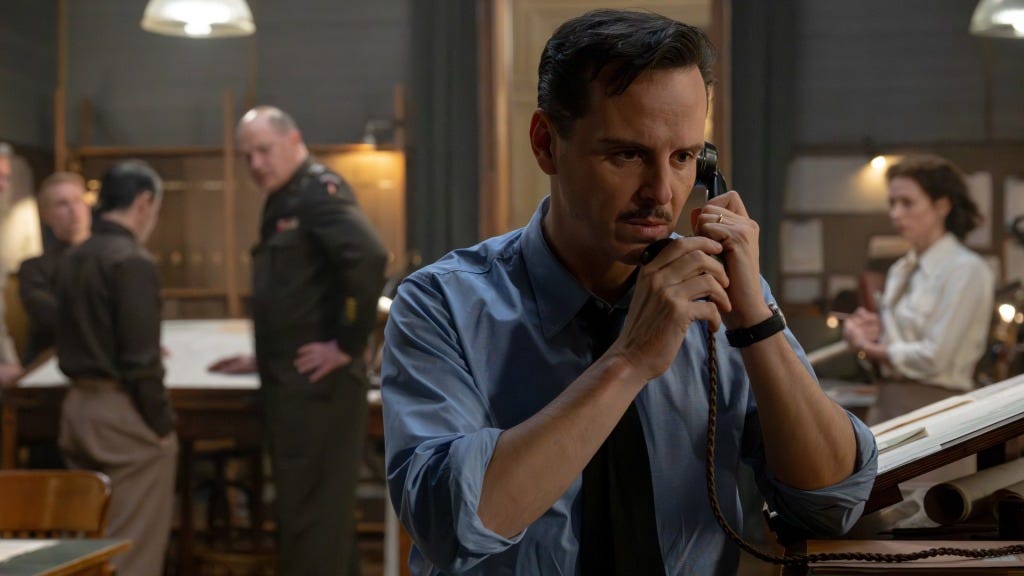
That’s where Scott comes in as Stagg, to nag Eisenhower and all his commanders with the overwhelming truth they don’t want to hear, that nature can’t be reined in. Predicted? To a degree. Defied? At one’s peril.
Scott conjures a marvelous blend of arrogance and steely-eyed realism. Rigorous sifting through meteorological evidence fuses with impatience and anger in this righteous and, yes, self-righteous scientist.
He faces overwhelming doubt from all the generals, especially a bluntly disrespectful Bernard “Monty” Montgomery, played with withering disdain by Damian Lewis.
Monty has no truck with Stagg’s dilly-dallying. “If we fail to launch, we will lose this war,” he tells the meteorologist. In other words, you’d better be right, “genius”. The fate of the West hinges on your advice. Make up your mind.
Which is what Stagg passionately wants to do, sticking to his contention that June 5 will be disastrous. But with, surprisingly, help from of all people Krick, Stagg spots a narrow window of only 12 to 18 hours.
Winds will ease and cloud cover will largely disappear on the morning of June 6. It’s not a perfect opening, but it’s workable and, best of all, the Nazis won’t have seen it coming. The Germans had poor weather reading capabilities in the Atlantic, where Stagg’s analyses had been heavily concentrated through most of the war.
As fate would have it, that relatively clear morning was an auspicious moment to strike. There were casualties, but Hitler’s generals never saw the massive interdiction coming.
Director Anthony Maras, adapting a play by Andrew Haig with a screenplay the two men co-wrote, keeps the action clutter-free and focused.
Maras also edited, and he makes war strategizing feel not so much heroic as ominously fateful, with the clock ticking. We always sense that there’s only so much these dedicated people can do.
Tactics here seem tough to devise yet somehow, with pluck and nerve, steerable. Cinematographer Jamie Ramsay’s compositions are so clean, his images so crystalline, that some force seems to be holding the Allies in its hand.
And the electrifying but never intrusive music by Volker Bertelmann, who also wrote the staggering, meditative Oscar-winning score for All Quiet on the Western Front (2022), sets a steady pace while never disturbing the script’s tense rhythm.
This is bold, intelligent moviemaking. It takes events we think we know and recasts them with a doubt that we weren’t aware of and shows us people who gave their all not on the battlefield but in tight, close rooms where overwhelming decisions had to be made – now.
That’s the edge on which men and women thrive or die. Pressure puts the audience in the eye of the storm, where, once again, like the participants, we watch and pray.
Great review! As you say, history seems inevitable in retrospect, but PRESSURE shows us how many unknown decisions lay behind the biggest moments.