
Hamnet (2025)
How far down did Shakespeare dig to create Hamlet? This deep, says this movie.

Hamnet (2025)
In theaters
If we allow an artist to do whatever he wants, it’s only fair to let anyone who portrays an artist do just as they like – assuming they’ll at least reckon with the known biographical facts about the artist’s life.
Four centuries of performance and scholarship have teased out meanings from every word of Shakespeare’s.
Yet very little is known about this master dramatist. Maggie O’Farrell’s 2020 novel Hamnet was praised as a bold imagining of how events in Will’s life might have impinged on his playwriting.
I haven’t read the novel, but since O’Farrell co-wrote this movie’s screenplay with its director, Chloé Zhao, I assume the book’s vision is honored.
Given the enormity of Shakespeare’s body of work, O’Farrell shows some moxie by zeroing in on a fact – the death in 1596 of Shakespeare’s son Hamnet at age 11 – and linking that heartbreaking loss to the playwright’s greatest work, Hamlet, written between 1599 and 1601.
That three-to-five-year time gap isn’t specified here, and I don’t think it needed to be. How does anyone process grief? An artist can drop a quarrel from last week or a memory from decades ago into his work and make it feel essential.
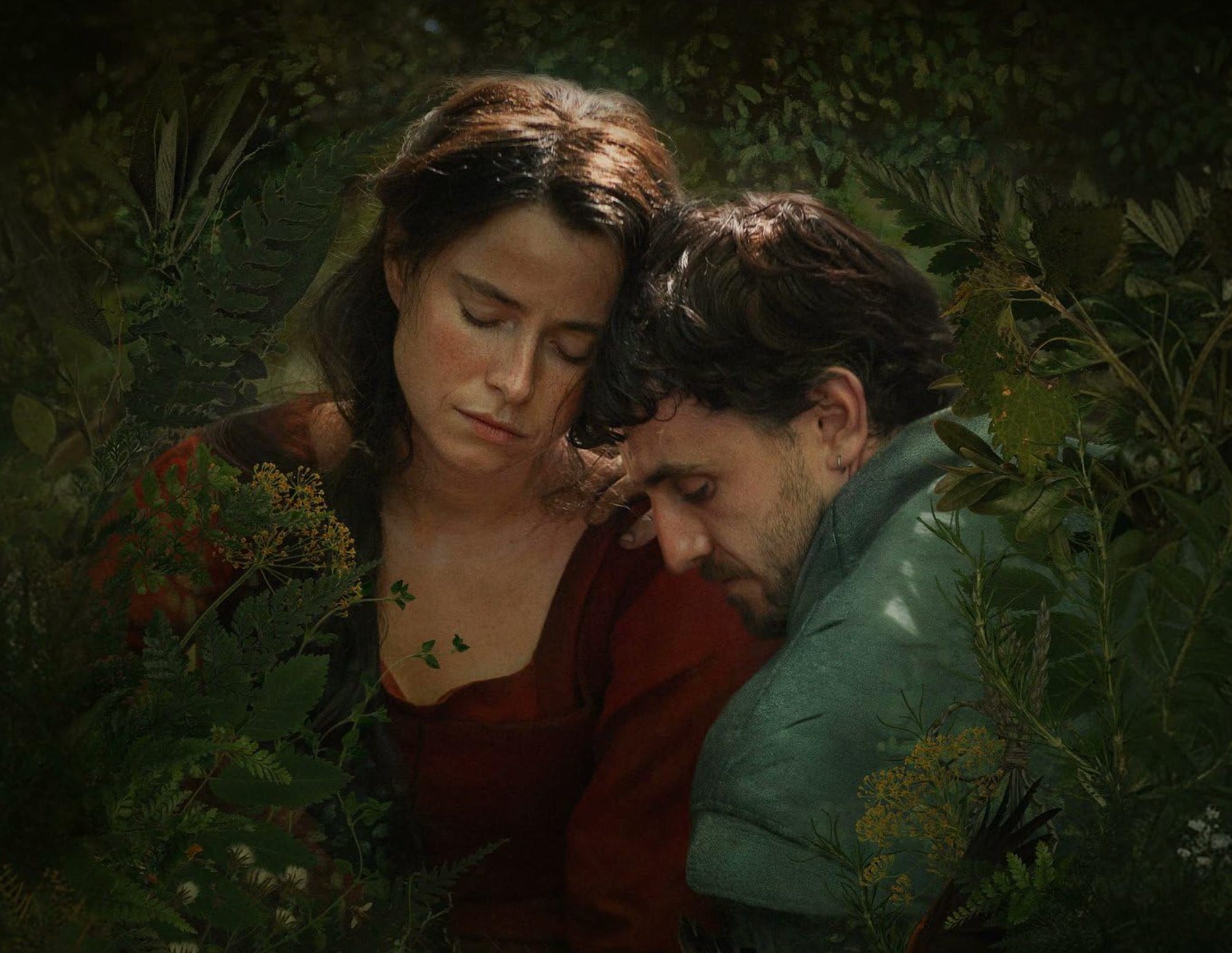
What’s more compelling is this script’s centering the action around Shakespeare’s deeply loving yet profoundly fierce wife Agnes (Jessie Buckley).
She’s most at ease in the forest, steeped in knowledge of herbs and plant life, and roams the woods with a hawk on her gloved arm, her insight into human motives matching the bird’s baleful eye.
She’s not much taken at first with Will (Paul Mescal), a glovemaker’s son who also works as a Latin tutor to pay off his ungrateful father’s debts. As we all know, father and son will take on a greater meaning for Shakespeare once he becomes a parent.
Yet the young unknown writer – he haltingly puts down words at night under candlelight – wins Agnes’ love and allegiance, and when she becomes pregnant, their bond needs to be fought for, since both families think the match a poor one.
He’s a penniless workman with no prospects and in the surrounding community she’s thought to be the unnatural offspring of a woodland witch, taken in by a local family.
Over both families’ objections, they marry. She determinedly disappears into the woods to give birth alone to their first child, Susanna. Will, restless and itching to try his gifts as a playwright, with Agnes’ encouragement moves to the only place he can realize his ambitions, London.
He shuffles back and forth between the city and the country, and Agnes gives birth to fraternal twins Judith and Hamnet.
We’re told onscreen at the outset that the names “Hamnet” and “Hamlet” were interchangeable in Elizabethan England, so the sound of his name reverberates every time we hear it.
Will is having increasing success writing comedies, and he’s able to move his family into the largest house in Stratford-upon-Avon.
Nevertheless, cleaving to her country roots, Agnes doesn’t join her husband in London. Whether his life there is as ribald as some Shakespeare scholars have suggested is never pictured for us.
The great city’s intoxications hover just out of reach beside the plain country tale we see unfolding.
That urban-rural separation is starkly deliberate. From the opening scenes of Will and Agnes in the forest to their early years of marriage when the children’s lives are split between mother and father, we see a crucial distinction taking hold.
We slowly realize we’re watching not the recounting of a life but a meditation on what creation can cost the creator. Will may live in a great city, but his wife and children’s lives are still nourishing his soul, burrowing into his art.
We know Shakespeare was formidably well-read, but he was something other than a formally educated man. He picked up the rules and axioms of learning, but on the evidence of his writing he was never in the least constrained by them.
His mind was eclectic, darting, and ravishingly given to wide, wild imagining. He saw through verbal sleight of hand and bent it to his own purposes.
The question this country-centered recounting of his life turns on is: How well did Agnes understand her man?
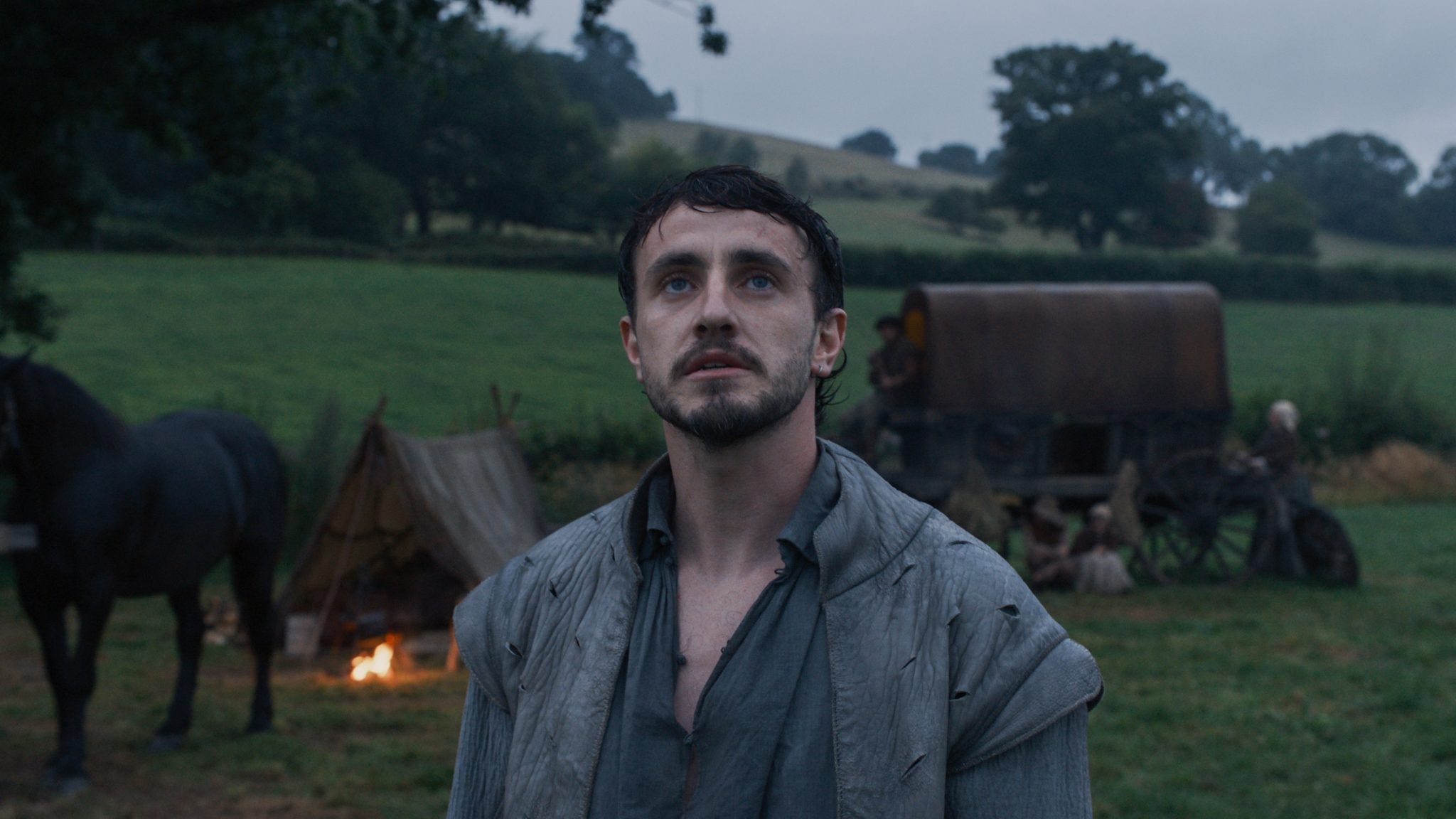
When a lethal plague (possibly bubonic) stalks the community, a wasting fever takes hold of Judith (Olivia Lynes), who’s stricken near to death. Her twin brother Hamnet (an astonishing Jacobi Jupe) lays beside her in bed. He’s promised his father he’ll look after his mother and sisters and “be brave” in protecting them.
By a force that stuns even the deeply spiritual Agnes, Hamnet coaxes the deadly fever out of his sister and moves it to himself.
He dies. Judith lives. Agnes’ anguished cry at her son’s sudden passing rings against the walls of the house, seems to shake the family’s very hold on life.
Shakespeare is in London. When he returns, too late to bid his son goodbye, Agnes is furiously unforgiving. “You weren’t here,” she rages.
He’s ashamed. But Will still has a thriving career as a playwright to return to in London.
And thus, over an unspecified time span we aren’t permitted to measure, Agnes hears of a play called Hamlet written by her husband. She’s mortified, cynical and curious all at once.
Accompanied by her brother Bartholomew (Joe Alwyn), she ventures to London for the first time to glean what her husband’s makings away from his family might amount to.
What held me and moved me here was precisely the constant visual uncertainty. Will’s life was nothing like a play. It was stalked by out-of-nowhere tragedy. Volatile nature tossed him and his family here and there.
I got a sense of how the man simply had to write; no order was coming from the world as he found it. He had to impose it.
This script has been a feverish what if from the beginning. Yet here’s where the movie becomes most audacious. We see Will – recall that we know Shakespeare was actor, playwright and manager at the Globe Theater – rehearsing the young actors who’ll appear in Hamlet.
Unsatisfied, he goads the teenaged actor playing the Prince to repeat lines, “Again . . . again . . . again,” chastising him for reciting the words without understanding them.
As he demonstrates how the To be or not to be speech ought to be delivered, passion pours from the playwright (and, not incidentally, made me want to see a full-fledged Mescal performance of Hamlet, so rich was the actor’s delivery).
At the actual first performance of the play to a packed Globe audience, Agnes and Bartholomew in the front row look on in amazement. Agnes at first is outraged to hear her son’s name uttered before a teeming, uncaring crowd.
But the power of the beleaguered young actor’s performance – given by Jacobi Jupe’s real life older brother Noah Jupe – sweeps her up in its anguish.
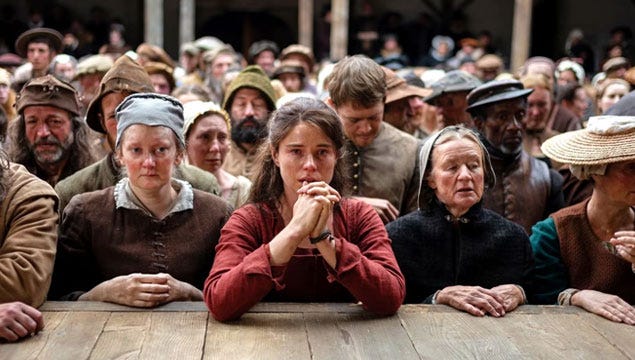
Will’s portrayal of the Ghost of Hamlet’s father – scholars say Shakespeare indeed performed this role – closes the circle for Agnes. Will’s grief and her own are finally joined.
This is bravura imagining. And it needed a filmmaker willing to let meanings emerge slowly from the settings, the physical places these people find and reveal themselves in. Buckley is so at one with the forest as Agnes, the actress seems almost a force of nature herself.
It’s wonderful to guess how such a commanding woman, not in the least bound by words or literacy or, least of all, the theater, could have remained key to the rise of Will in the world.
Yet she feels foundational, inescapable here. Buckley makes a lively case for which earthy passions Will drew on and how much brimming vitality he had to come home to, answer to and respect.
Mescal’s Shakespeare feels every inch the volatile young artist not fully aware of, always wrestling with, how wide his creative powers might roam. The moment the actor appears on screen he doesn’t look like he did in any other role I’ve seen him in.
This isn’t the lonely young father reaching out to his confused daughter in Aftersun (2022), a role that earned Mescal an Oscar nomination as Best Actor. Nor is it the gifted vocalist, another conflicted artist struggling to give love its due, in this year’s The History of Sound.
Somehow, as Shakespeare, he expresses artistic expectancy and hope as well as maddening doubt and self-flagellation. A driving dissatisfaction slithers under the whole performance.
I wanted more screen time for him in the role, even as I was thrilled that he captured the investment a writer puts into his work that an audience likely will never realize. Maybe artistic work remains powerful in part because of what we don’t, and likely never will, know about the creator himself.
Zhao showed a deft directorial hand in depicting out-of-the-way people whose insights might not be apparent in 2020’s Nomadland. Oscars were awarded to the movie as Best Picture and to her for Best Director.
Which makes her an inspired choice to co-write and direct this lucid but slippery material. She relies on suggestion, letting mystery linger onscreen as we slowly work through our puzzlement. The pace is leisurely, contemplative, until it suddenly jolts.
She’s a master of the middle shot. In scene after scene, she starts with the camera at mid-distance and keeps it there. We’re forced to view the screen from one side to the other in order to grasp what’s at stake. Is it surprising that her staging should be “theatrical” in a story about the greatest playwright of all time?
Her adept cinematographer Lukasz Zal fills the screen with lush greens in the countryside, but can capture confining Tudor architecture, with its broad, intimidating interiors, by deploying small, vital points of light.
I didn’t spot any key light in the interiors. Candlelight seemed to catch the actors in expectancy, waiting for a revelation that available light wasn’t yet revealing.
What held me and moved me here was precisely that constant visual uncertainty. Will’s life was nothing like a play. It was stalked by out-of-nowhere tragedy. Volatile nature tossed him and his family here and there.
I got a sense of how the man simply had to write; no order was coming from the world as he found it. He had to impose it.
Is this imagining of the death of Hamnet as a direct pipeline to the gargantuan, overpowering Hamlet plausible?
Just barely, it seems to me. But that approximation, that guesswork, at the end of the movie felt like an artistic manifesto all on its own. It matters less whether O’Farrell and Zhao are clever at speculating. It’s fundamental that they let art assert itself for all of us to see how fragile, life-dependent, its making can be.
Hamlet the character and Hamnet the young boy may not completely fuse. It’s more important to know that something – we may never know exactly what – could have tied them together in one man, father to the child, creator to the benighted Prince.
Max Richter’s haunting score pulls us through the ordeal. It’s an orchestral pining for a peace that may never come. Rest, perturbed spirit, Richter’s music seems to whisper throughout, mirroring those final words of Hamlet to the departing Ghost of his father.
I wanted all these people to find rest, without knowing whether they were ever actually able to. All we can say for sure is that, like the Prince’s distraught mother, they’ve gone the way of all flesh.
another one to add to my list (it's not long!)